


In one scene in John Steinbeck’s The Grapes of Wrath, set in Oklahoma in the mid-1930s, a tractor arrives, and one man on a machine suddenly does the work of a hundred people. Families of farm workers, like the Joads, the novel’s protagonists, are driven off the land, and tragedy follows as the family heads west, where promised work proves scarce to come by. Today, as AI spreads across the economy, the old fear of machines putting humans out of work is running high once again.
However, technology has advanced for centuries, shuffling workers among occupations, industries, and regions without making human labor obsolete. As machinery pushed millions of Americans away from farming over the past century, most workers moved to factories, towns, and cities. They ended up with more comfortable lives than their predecessors plowing the fields. The AI economy will likely follow the same path: destroying jobs while creating better ones.
In the vocabulary of AI engineering, a “human in the loop” is a person who reviews, approves, or corrects what an automated system does. The phrase also fits a much larger pattern. Tools and machines keep saving human labor, yet humans stay in the loop, doing what machines still can’t, and more work remains as machines raise total output. The economist Joseph Schumpeter called the process of technology destroying old jobs, firms, and industries while creating new ones “creative destruction.” Workers in a dynamic economy need to be adaptable, yet history gives us reason to feel more excitement than fear about AI-driven job loss.
The Great Declines in Farm and Factory Work
Technological job loss is real, and farms are Exhibit A. In 1800, about three-quarters of American workers were farmers. The farm share of the workforce fell over the 19th century, but the number of farm workers continued rising, reaching 11.6 million in 1910 in one historical series. Then farm employment entered a long decline. Between 1948 and 2017 alone, it fell 81 percent, even as agricultural output nearly tripled. By 2022, direct on-farm employment accounted for just 1.2 percent of US jobs. Americans today eat more and spend far less of their income on food. In 1929, buying food accounted for 23.4 percent of an average person’s disposable income and only 9.7 percent in 2025.
Three forces drove declining farm employment. Technology was the biggest: tractors, combine harvesters, better seeds, pesticides, and fertilizer let farms grow more with far less labor. Rising wages sped things up. As factories bid up labor costs, machines that were too expensive when hired hands were cheap became a bargain. Rising demand for food pulled in the opposite direction, toward the need for more farm jobs, but only mildly. People buy more food as they get richer, but not that much more, because there’s only so much a person can eat, and more of each food dollar goes to factory processing and restaurants.
Steinbeck’s story captures a real collapse in the farming sector, but the Joads’ miseries owed less to tractors than to the Great Depression, which technology didn’t cause. Milton Friedman traced its severity to a catastrophic monetary contraction in 1929–1933. Jobs in town disappeared. Farm employment actually rose in the early 1930s as jobless city dwellers retreated to the land. In normal times, farm workers drifted steadily into factory and town jobs that were more comfortable and better paid.
Manufacturing followed a similar path decades later. Factory employment peaked at 19.6 million in 1979, drifted down until 2000, and then fell by nearly six million jobs in a decade, driven by trade and productivity growth. However, it has since regained about one million. One Ball State University study attributed about 88 percent of the decline in US manufacturing employment between 2000 and 2010 to productivity growth, rather than foreign trade. Factories have become Exhibit B for technology-driven job loss.
These transitions weren’t painless. Some displaced workers never regained their former earnings, and some towns have emptied. My grandmother grew up in Osgood, Idaho, then a community of potato farmers. When I visited in 2024, little of that community was left. But most displaced workers, and especially their children, went on to do better-paid and more comfortable work somewhere else.
Who’s next? Self-driving vehicles may take millions of drivers’ jobs, and AI is already displacing substantial amounts of customer service work. What’s new about AI is that it threatens highly educated workers who never expected to be automated. Software engineers, writers, and translators are feeling the disruption now, and doctors, lawyers, and professors are wondering whether a machine could do their jobs better. But the disappearance of particular jobs does not mean the disappearance of work.
Where the Lost Jobs Go
To see why work will remain, follow the money. When technology cuts costs on the farm, food gets cheaper, and people buy more of it, but they also have more money left to spend on something else, like health care, travel, restaurant meals, education, and new gadgets. Jobs multiply in sectors with elastic demand or slower productivity growth.
Looking only at the industries that shed workers and concluding that work is disappearing is what economists call a “fallacy of composition.” What’s true of some of parts of the economy may not be true of the whole. The typical pattern is for technology to shrink employment in one industry, or several industries, even as the purchasing power it releases supports jobs elsewhere, and the total number of jobs increases.
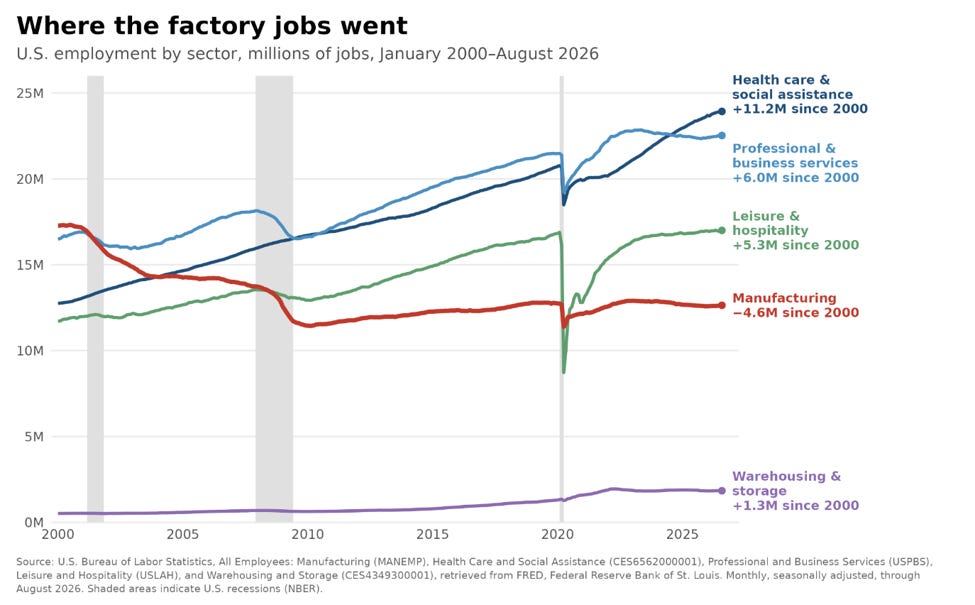
Since 2000, as the United States lost about 4.6 million factory jobs, just four sectors added nearly 24 million. New jobs in health care and social assistance, professional and business services, leisure and hospitality, and warehousing and storage have far outpaced factory job losses. Employment in all of these sectors grew faster than population growth, jointly adding more than five jobs for every factory job lost (Figure 1).
Figure 1
How Jobs Get Better
Jobs don’t just return; they improve over time. When a major new technology raises productivity across many industries at once, as AI is expected to, the whole economy grows richer. As real incomes rise, demand grows fast enough that many industries sell far more and need more workers, not fewer. Because each worker produces more, employers can and must compete harder for workers, offering higher pay, shorter hours, and safer, more pleasant conditions.
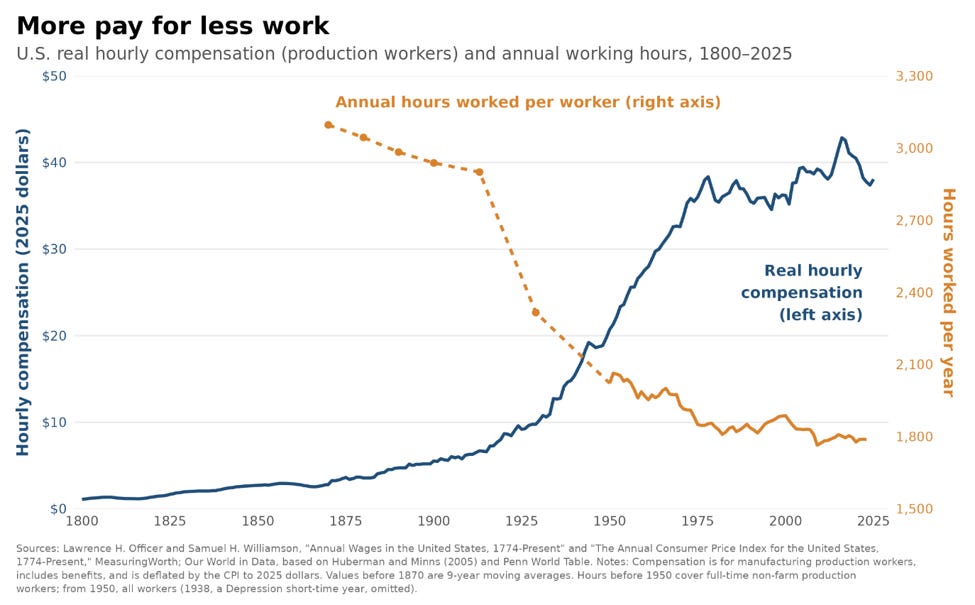
Henry Ford’s Model T is the classic example of this dynamic. Its nominal price fell from about $825 in 1909 to under $300 by the mid-1920s, and sales soared into the millions. In inflation-adjusted terms, the price drop was even steeper. In 1914, Ford famously doubled wages to $5 a day to attract and keep workers. From the late 19th century through the mid-20th century, as railroads, cars, electricity, telephones, and assembly lines spread through the economy, many industries followed that pattern. For workers, the result was dramatic: far higher pay for far fewer hours of work (Figure 2).
Figure 2
Pay and hours aren’t the only gains from creative destruction. Work has also grown far safer: by the time the Occupational Safety and Health Administration was created in 1971, worker fatalities had already fallen by roughly two-thirds from their pre-World War I levels. Machines have taken over much of the drudgery, leaving people with more work that calls for judgment and creativity.
Measured wage growth slowed beginning in the 1970s, along with productivity growth, though HumanProgress’s time-price analysis finds that an hour of work still buys about 20 percent more goods and services than it did in 2000. That statistic, along with Figure 2, likely understates recent gains because both use the Consumer Price Index, which likely overstates inflation. Still, the fast wage growth of the mid-20th century hasn’t returned. A powerful new general-purpose technology like AI should, if anything, end what economist Tyler Cowen calls “the Great Stagnation” and bring fast wage growth back.
The Future Flourishing of Human Labor
In May 2025, Anthropic CEO Dario Amodei warned that AI could wipe out half of all entry-level white-collar jobs and push unemployment to 10–20 percent within one to five years. Goldman Sachs estimates that 15 million workers, or nine percent of the workforce, will be displaced over the next decade. History casts doubt on these forecasts. Still, displacement over a decade differs from unemployment at any one time. Workers move on to new jobs.
Humans will stay in the loop for two reasons. First, AI still depends on people for initiative, judgment, creativity, and critical thinking. Second, as the roboticist Hans Moravec observed, computers find tasks that are intellectually “hard” far easier than physically “easy” tasks that almost anyone can do. Right now, investment in AI training data centers is creating thousands of construction jobs. A 2024 study from Virginia’s Joint Legislative Audit and Review Commission estimated 35,000 direct jobs from AI, mostly in construction, supported by the data center industry. Similarly, a Goldman Sachs analyst forecast 500,000 net new jobs by 2030, especially for construction workers and electricians, as power-generation capacity expands to meet the needs of growing data centers. The Economist reports an AI jobs boom. As AI makes the economy richer, the wealth it creates keeps pulling workers back into the loop at higher wages.
Steinbeck’s story deserves to be remembered, not as a prophecy or even a cautionary tale, but as a reason to be grateful that we’ve left it behind. The Joads took to the road in search of work, a home, and a better future for their children, and found only disappointment. Today’s workers face much better fortunes, even if a few surprises and setbacks are likely. Despite everything, human labor is already thriving as never before, and the work of the future will be even better.
Your chart shows stagnant real hourly compensation of production workers over half a century. That is the period of the digital revolution. So, your argument that new technology benefits everybody in the long run collapses.