


When Paul R. Ehrlich, the famed Stanford University biologist and author of the bestselling 1968 book The Population Bomb, died last month, he was 93 and unrepentant for a lifetime of doom-mongering. In the book he warned, “The battle to feed all of humanity is over. In the 1970s and 1980s hundreds of millions of people will starve to death.” In 1970, he predicted, “Sometime in the next 15 years, the end will come—and by the end, I mean an utter breakdown of the capacity of the planet to support humanity.” Over the succeeding decades, he maintained that less-than-cheerful disposition. In 2013, he wrote that “a global collapse appears likely.” In 2018, he stated that a “shattering collapse of civilization is a ‘near certainty.’” In 2024, he gave his last interview, reiterating his position that humans are destroying the planet and committing civilizational suicide.
Ehrlich’s confident and, to some, attractive demeanor made him a television star with more than 20 appearances on Johnny Carson’s The Tonight Show—a record unmatched by any other individual guest. Slowly but surely, the techno-optimistic 1960s (Star Trek 1966-1969, The Jetsons 1962-1963, Thunderbirds 1965-1966, etc.) gave way to the doom and gloom of the 1970s. Consider the 1973 film Soylent Green, set in an overcrowded and overheated New York City in 2022. Food is scarce, and most people survive on processed wafers made by the Soylent Corporation. A detective played by Charlton Heston investigates the murder of a wealthy businessman and uncovers a horrific secret: Soylent Green, marketed as a new food source, is made from human remains. Its final revelation made “Soylent Green is people!” one of cinema’s most famous lines.
The first Earth Day—April 22, 1970—came during the transition from optimism to doom and gloom, and Ehrlich played a role in that. He served on the steering committee put together by Earth Day founder Sen. Gaylord Nelson and spoke on campuses across the country. So it’s not surprising that, as the Columbia Climate School has noted, Earth Day was infused not only with the usual and more understandable environmental concerns over pollution and carcinogens, but “Malthusian” worries over overpopulation and overconsumption of resources.
The first Earth Day was a massive success. About 20 million Americans participated. Lectures and rallies took place at more than 2,000 college campuses, 10,000 elementary and high schools, and thousands of other locations around the country. Forty-two states adopted resolutions endorsing Earth Day, and Congress recessed so that legislators could take part in activities back home. In September 1970, Congress strengthened the 1963 Clean Air Act. That December, President Richard Nixon created the Environmental Protection Agency.Long before Ehrlich warned we were stripping the planet of resources, the English preacher and economist Thomas Robert Malthus wrote in his 1798 Essay on the Principle of Population that human numbers, if left unchecked, grow geometrically, while food supply grows only arithmetically. From that simple and, as it turned out, badly mistaken idea, he concluded that humanity would always press against the limits of subsistence. If people multiplied too quickly, nature would restore balance through war, famine, and plague. Those were his “positive checks” on overpopulation and overconsumption. He regarded them as awful, but also as inevitable unless societies adopted “preventive checks,” such as celibacy, that limited reproduction. It is easy to see why Malthus’ argument seemed persuasive. For most of human history, harvest failures could ruin entire populations. Malthus looked at that long record and saw a pattern. The problem was that he took a pattern that had held for centuries and assumed it would hold forever. He mistook a long chapter of human experience for an eternal law of nature.
In fact, Malthus had already lost his main argument before his essay even appeared in print. Between 1700 and 1798, the population of England rose from 5.2 million to 8.44 million, an increase of 62.3 percent. Over the same period, nominal GDP per person rose from 12.37 British pounds to 23.97 pounds, an increase of 93.8 percent. The nominal price of a four-pound loaf of bread, a staple that fed much of the poor, rose from 5.2 pence to 7.4 pence, or 42.3 percent. Because incomes rose much faster than the price of bread, the latter became 36.2 percent more abundant, not less. Put plainly, as England added more people, the bread of the poor became easier to afford.
Why did Malthus miss what was happening? Partly because the Malthusian thinking, shared by Ehrlich, reduces human beings to their appetites. It sees more mouths and stomachs, but not more hands and minds. It assumes that each additional person means one more claimant on a fixed stock of food and other goods. What it does not see is the human capacity to cooperate, trade, discover, invent, and adapt. Human beings are not trapped in the same ecological logic as bacteria in a dish or buffalo on a plain. We exchange with one another. We build institutions. We create tools. We improve production methods. We substitute one material for another. We grow more from the same soil—sometimes much more. In other words, we create new knowledge. Atoms without knowledge are mostly useless. New knowledge organizes atoms into fertilizer, irrigation systems, container shipping, refrigeration, or high-yield seeds. That is the variable that Malthus ignored and that led to Ehrlich’s very public humiliation.
Unlike Malthus and Ehrlich, the University of Maryland economist and Cato Institute senior fellow Julian Simon understood that scarcity is not the end of the resource story. It is just the beginning of a human response. Higher prices signal a problem. Those higher prices then encourage knowledge creation, and new knowledge leads to greater abundance. And so it was that in 1980, Simon proposed a 10-year futures-style bet. Ehrlich, along with ecologist John Harte from the University of California-Berkeley and John P. Holdren, a Berkeley scientist who later became President Barack Obama’s science adviser, jumped at the opportunity. The bet ran from September 29, 1980, to September 29, 1990.
Ehrlich’s group chose five metals: chromium, copper, nickel, tin, and tungsten. They fixed the starting value of the chosen quantities at $1,000 in 1980 and agreed to compare the inflation-adjusted value of that same basket 10 years later. If the real price of the basket rose, Simon would pay Ehrlich’s group. If it fell, Ehrlich’s group would pay Simon. The wager, therefore, used prices as a proxy for scarcity. When the term ended in 1990, all five metals were cheaper. Ehrlich sent Simon a check for $576.07, reflecting a 36 percent decline in the inflation-adjusted price of the basket. The check was signed by Paul’s wife, Anne Ehrlich. There was no accompanying letter. Simon replied with a thank-you note and offered to raise the stakes to $20,000 for a future bet, but Ehrlich declined.
The Simon Abundance Index, which Dr. Gale L. Pooley and I publish every year on Earth Day, is named after Julian Simon. It is a deliberate continuation of the quantitative analysis of the relationship between population growth and resource abundance that Simon’s bet with Ehrlich began. Unlike Simon and Ehrlich, who measured the abundance of resources in inflation-adjusted dollars, we look at “time prices.” Money prices are distorted by inflation and disputed deflators. Time prices solve that problem by dividing a good’s money price by hourly income, showing how long a person must work to buy it. They capture both falling prices and rising wages, require no inflation adjustment, and allow comparisons across countries and centuries. Time is universal, cannot be printed, and reflects the real cost people pay: hours of life. Time prices provide a clearer, simpler, and more meaningful measure of resource abundance than money prices for ordinary people.
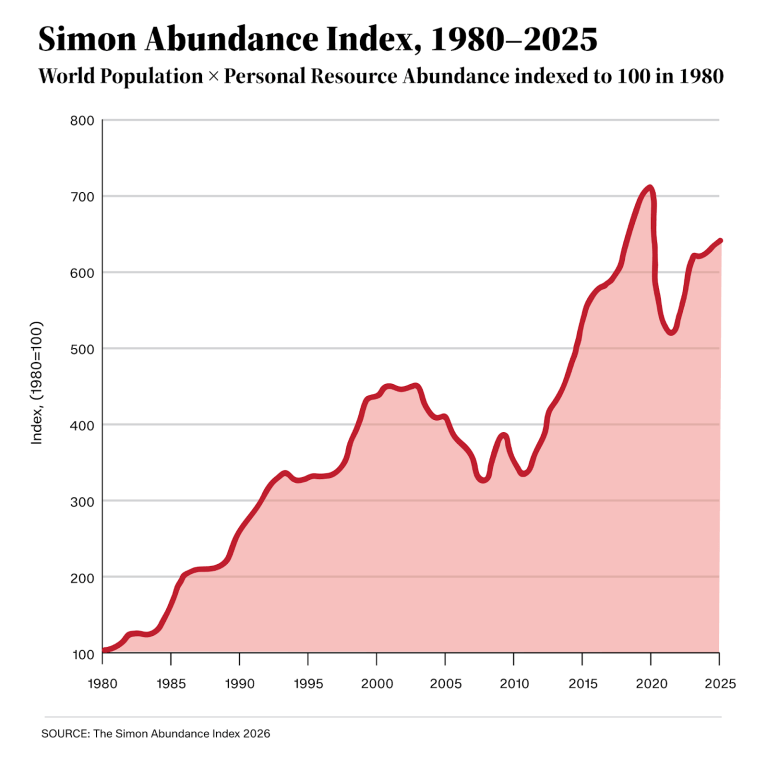
By this measure, the last 45 years have been a rout for the pessimists. The 2026 report says that the Simon Abundance Index stood at 636.4 in 2025, up from a base of 100 in 1980. That means Earth was 536.4 percent more abundant in 2025 than in 1980. All 50 commodities, including fuels, such as crude oil, coal, and natural gas, food, such as chicken, beef, and lamb, and metals, such as aluminum, copper, and gold (yes, even gold!), in the dataset were more abundant in 2025 than they were in 1980. The global abundance of resources increased at a compound annual rate of 4.2 percent, doubling about every 17 years. In the 42 countries tracked by the report—accounting for 85.9 percent of global gross domestic product and 66.3 percent of the world’s population—none saw lower resource abundance in 2025 than in 1980. That is not what a species trapped in Malthus’ arithmetic is supposed to produce.
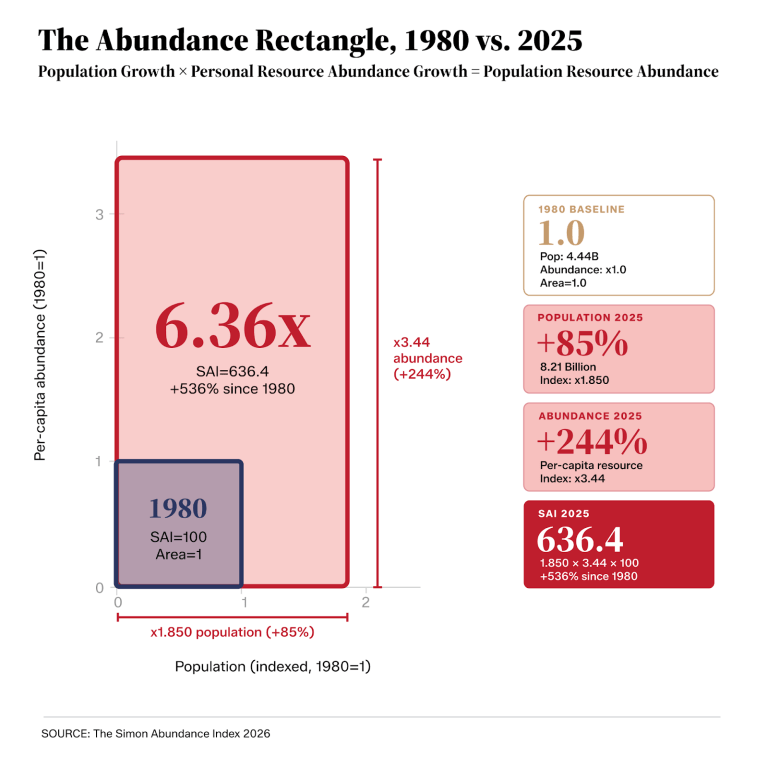
The mechanics of that gain matter. Between 1980 and 2025, time prices for the 50 commodities fell by an average of 70.9 percent. What required an hour of work in 1980 required about 18 minutes in 2025. The same hour of work that bought one unit of a typical commodity in 1980 bought 3.44 units in 2025. That is a 244 percent increase in personal resource abundance. At the same time, the world population grew by 85 percent, from 4.44 billion to 8.21 billion. Put those two changes together and you get the index’s central finding: For every 1 percent increase in global population, population-level resource abundance grew by about 6.3 percent. Resources growing at a faster pace than the population is what Pooley and I call superabundance. It is the opposite of Malthus’ conjecture that each additional person leaves less for everyone else.
The critics sometimes retreat to complaining about the short-term noise, as though any temporary spike in prices confirms the Malthusian creed. Our report addresses that, too. In 2025, 27 commodities became more abundant, and 23 became less abundant. The abundance of oranges rose the most, by 65.6 percent, while coconut oil’s abundance fell the most, by 36.3 percent. But commodity markets always swing because weather changes, disease hits crops, wars disrupt transport, and investment arrives late or early. Simon never argued that every price falls every year in a straight line. He argued that scarcity signals provoke adjustment. A temporary setback is not a vindication of Malthus. It is often the first stage of a correction. That is why the long trend matters more than the annual changes.
Our findings do not show that pollution is imaginary or that every environmental question has been solved. It has not. But environmental problems should be addressed as side effects of human flourishing, not as evidence that human flourishing itself is a mistake. The Earth Day mentality blurred that distinction. It converted planetary stewardship into misanthropy. It taught millions to look at a growing population and see only a burden, never a contribution. It treated the human animal as uniquely destructive when, in fact, people are the only animals who can recognize ecological damage and fix it. It is new knowledge—human knowledge—that gives societies the capacity to clean rivers, regulate toxins, build sewage systems, improve fuel efficiency, and move from dirtier technologies to cleaner ones. A poor society burns what it can find and dumps what it cannot manage. A rich society can afford scrubbers, pipelines, wastewater treatment, research labs, and better rules.
The green extremists often speak as though abundance is the disease, when in fact abundance is usually what makes environmental improvement possible. And so, despite half a century of doomsaying, the Earth is not collapsing under the weight of humanity. It is supporting far more people who can command far more resources with far less labor than their predecessors could. That is not the picture of a planet in terminal decline. It is the picture of a planet made more habitable by the one species clever enough to improve it. The Earth is not a museum piece. It is a working planet inhabited by learning beings who desire and are entitled to flourish.
This article was originally published in The Dispatch on 4/23/2026.
The Malthusian mindset, rooted in the ideas of 18th-century economist Thomas Malthus, and best illustrated by "the green movement" , is a deeply pessimistic view of human progress that assumes population growth will inevitably outstrip food production and natural resources.
Their whole 'mindset' is 'anti-human' including Opposition to Aid: A tendency to oppose welfare or aid for the poor, arguing that such assistance encourages more children, ultimately increasing misery and starvation. .
Modern "Neo-Malthusians" extend this thinking to resource depletion and environmental degradation, predicting ecological collapse if population and consumption rates are not controlled.........THAT IS , controlled by them of course !!!!
.
Paul R Ehrlich’s core neo-Malthusian argument laid out so pessimistically in his 1968 book , was that overpopulation would exhaust the supply of food and natural resources, leading to a cascade of catastrophes around the world. “The Population Bomb” opens with a bold prediction, “The battle to feed all of humanity is over. In the 1970s and 1980s hundreds of millions of people will starve to death in spite of any crash programs embarked upon now.”
With his BOOK and his PESSIMISM he single-handedly DESTROYED THE LIVES and POTENTIAL-LIVES of generations of Chinese and Indian children , either not-conceived , aborted or terminated
STATEMENTS LIKE THESE : “If I were a gambler, I would take even money that England will not exist in the year 2000,” Ehrlich prophesized during a speech in 1971.
He also said that the U.S. would be rationing water by 1974, and food by 1980.
That smog in L.A. and New York would cause some 200,000 deaths per year.
That Americans born after World War II wouldn’t live past 50."
Curiously "old misery guts" Paul R Ehrlich 'hung around' , miserably one assumes , until he was 93
before he eventually died !.
THUS PROVING in the process THAT HE WAS TOTALLY WRONG ABOUT EVERYTHING !
.
While some may mourn his loss I don't !
I think that his very existence served to TARNISH THE GOOD NAME of PAUL EHRLICH , the brilliant German microbiologist ! [ Please 'click on the link ' below and READ ABOUT HIM ! ]
https://www.sciencehistory.org/education/scientific-biographies/paul-ehrlich/
THIS was a man who was truly a contributor to mankind !
He coined the term " magic bullet"... It was these antibodies, in search of toxins, that Ehrlich first described as magic bullets.......and “chemotherapies” were to be the new magic bullets.
They were SPECIFIC and AIMED AT SPECIFIC DISEASE AGENTS !
Silver bullets are legendary, not just for killing werewolves, but for destroying various supernatural entities in folklore, specifically witches, vampires, and evil spirits. Because silver was traditionally viewed as a pure, holy metal capable of breaking curses, it was used to kill monsters that resisted conventional weapons. PRETTY RANDOM and NOT SPECIFIC !
WEIRDLY , the term 'silver bullet' arose from horror stories and a long-held belief that "the most common way of killing a werewolf is by using a silver weapon, like a dagger, sword, or, in modern times, a bullet." , and the two terms became confused !
Now , PEOPLE [ many of whom should know better ] use the TWO TERMS interchangeably and inaccurately !
The Cato Institute publishing a techno-optimist rebuttal of Malthus is not surprising. It is what they do.
The article is internally coherent, and that is precisely the problem. It measures what it wants to measure and declares victory.
A few of the accounting gaps they leave out:
Biodiversity. Species extinction is running at 100 to 1,000 times the natural background rate. No commodity index captures this because extinct species have no market price. By the article's metrics, the passenger pigeon's disappearance registers as zero.
Soil. Roughly a third of the world's topsoil has been degraded since 1960. We are growing more food from less soil by injecting it with oil-based fertilizers. That is not abundance. That is a loan with no repayment plan.
Water. Major aquifers — the Ogallala in the US, aquifers across India and China — are being drawn down faster than they recharge. Again, no market price until they run dry.
Climate. The article mentions pollution briefly and waves it away. It does not mention that the "abundance" it celebrates was largely purchased by burning 400 million years of stored carbon in 200 years. The bill has not arrived yet in their index. It is arriving everywhere else.
The distribution problem. Global resource abundance measured in aggregate is compatible with a billion people in acute food insecurity. The index obscures who gets the abundance and who gets the waste.
The deeper dishonesty is philosophical.
The article argues that human ingenuity has always solved scarcity and therefore always will. That is not an argument. That is pretense of logic. The fact that we have not yet hit a wall does not mean there is no wall.
Malthus was wrong on timing and mechanism. He was not wrong that a species can exceed the carrying capacity of its environment. We have simply been very creative about pushing the reckoning forward.
The Cato Institute is celebrating our creativity. What they are not measuring is what we owe.
A classic piece of propaganda by the very culprit of the problems we face.
——
The Cato Institute is a Washington-based libertarian think tank founded in 1977 with substantial funding from the Koch brothers network. It exists to produce intellectual cover for deregulation, free market absolutism, and the systematic dismantling of public institutions — and has been doing so with considerable polish for nearly fifty years.