

2025 in Review
Thankfully, we at Human Progress are not the only rational optimists writing on the internet.
Before the usual news roundup, I’d like to share a few reflections from our fellow travelers on the progress the world enjoyed this past year.
Saloni Dattani has compiled a list of the most important medical breakthroughs of 2025. Avid roundup readers will recognize many of these innovations, but Saloni’s expert curation and explanation make this list well worth reviewing.

Roger Pielke Jr. writes that 2025 may have seen the lowest death rate from extreme weather in history. He notes that this good news is not a fluke, but part of an enduring trend of disaster resilience:
Make no mistake, 2025 is not unique, but part of a much longer-term trend of reduced vulnerability and improved preparation for extreme events. Underlying this trend lies the successful application of science, technology, and policy in a world that has grown much wealthier and thus far better equipped to protect people when, inevitably, extreme events do occur.

According to Jeff Asher, a much-cited crime data analyst, crime fell dramatically across the United States in 2025. He finds the same trend in many different datasets, including those from law enforcement agencies, the CDC, and municipal reports.
The eminent blogger Noah Smith has a (paywalled) list of some more heartening trends in American society. Many of our more pernicious social ills, such as substance abuse, suicide, obesity, and social atomization, appear to have alleviated over the past few years.
Africa remains the most troubled region of the world, suffering from persistent poverty, corruption, terrorism, and brutal wars. However, it’s not all bad news. Ken Opalo notes some of what’s going well on the continent, including widespread “catch-up” growth and economic liberalization in Ethiopia.


Finally, if you enjoyed our megalist of 1,084 progress stories, you might also appreciate these excellent lists from The Progress Network and Arb Research/Renaissance Philanthropy.
On to the news.
Economics & Development
A recent meta-analysis of the effects of economic inequality on mental health found that economic inequality does not worsen our psychological well-being. After surveying 168 studies, the authors found a small negative correlation between economic inequality and mental health, but the relationship disappeared after adjusting for publication bias.
There’s a common claim in progressive housing debates that deregulating real estate mainly produces luxury housing for the rich, with little benefit to average renters. The data show that to be false: according to CoStar, a real estate research company, US cities that allowed the most construction over the past 5 years also saw the largest declines in rent.

Javier Milei’s deregulatory reforms are reviving stagnant industries in Argentina, including salmon farming, copper mining, and oil drilling.
Energy & Environment
Local authorities in Japan’s Niigata prefecture have approved a plan to restart the nuclear power plant at Kashiwazaki-Kariwa, the world’s largest nuclear facility that was unwisely shut down after the Fukushima disaster in 2011.
Pumped hydro, the oldest and most reliable form of large-scale energy storage, is still evolving. An article in Wired magazine describes several efforts to refine the technology, including a company that mixes dense particles into the water, increasing its mass and therefore the amount of potential energy it can store.
Politics & Freedom
China has designated the province of Hainan as a duty-free customs zone, allowing companies based on the island to import materials and components without tariffs and bring their goods into the rest of the Chinese market tariff-free if they meet local value-added and regulatory requirements.
Science & Technology
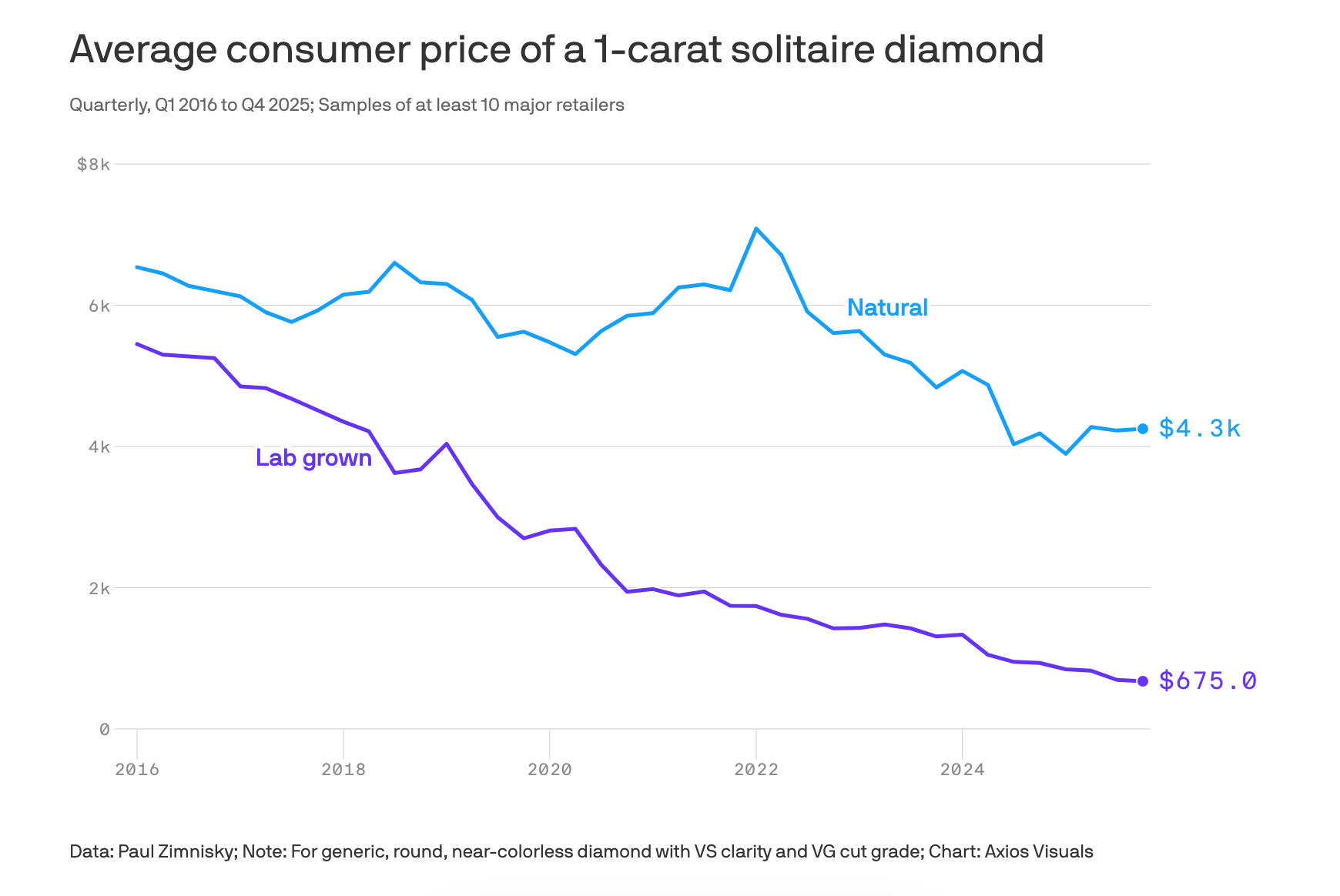
Synthetic diamonds are not only getting cheaper but also driving down prices for their natural counterparts. Consumers are responding by purchasing larger stones.
Scientists at the American Museum of Natural History discovered more than 70 new species in 2025: living, extinct, and mineral.
I appreciate the optimistic news you provide. But I recently moved out of the Phoenix metro area because the quality of life in the city has significantly deteriorated over the past 10 years. Yes, a lot more apartments have been built. Some say overbuilt. An abundance of less expensive housing has brought an influx of people from Southern California, reducing the quality of life in Phoenix. Phoenix isn't as nice as it used to be, and that's a significant reason rental prices have gone down.
tell trump about the decrease in crime