

Economics & Development
India and the European Union have agreed to an enormous free trade deal, with both sides committing to cut or eliminate tariffs on over 95 percent of traded goods by value.
Energy & Environment
Conservation and biodiversity:
According to recently published field research, polar bears living in the Svalbard archipelago have been getting fatter over the past few decades. This is especially interesting because sea ice around Svalbard is shrinking much faster than in other polar bear habitats, something widely expected to harm polar bear populations by shortening their seal-hunting season.
An ambitious attempt to restore the Galápagos Island of Floreana to its pre-discovery state is making progress. The initiative aims to eradicate invasive rats, cats, and other non-native animals, rebuild native habitats, and reintroduce around a dozen locally extinct species, including giant tortoises. Conservationists report that native wildlife is already starting to rebound.
Natural disasters and pollution:
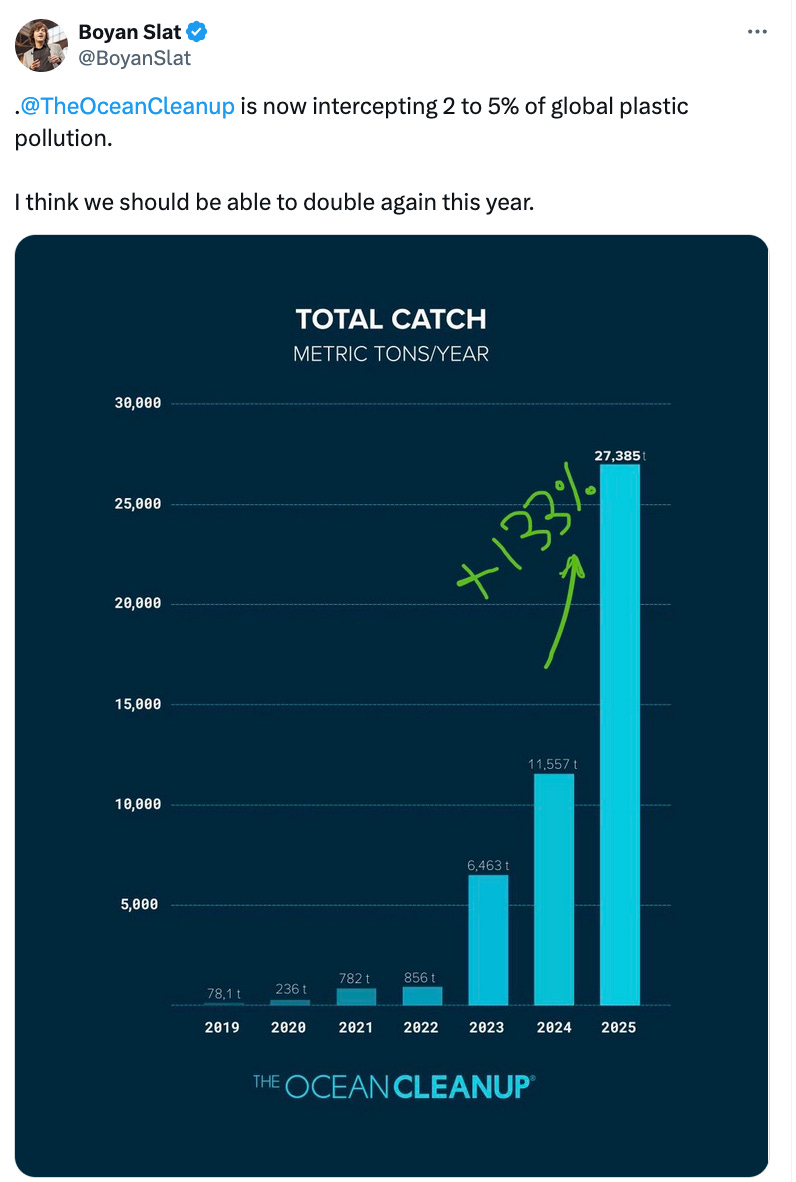
Boyan Slat claims that his non-profit The Ocean Cleanup removed over 27,000 tons of plastic from the world’s waterways in 2025, which he estimates is 2 to 5 percent of annual plastic pollution. If the operation can maintain its current rate of growth, it could meet its goal “to clean up 90% of floating ocean plastic pollution by 2040.”
As countries begin to develop economically, they tend to damage their environment. However, after reaching a certain level of wealth, the trend reverses, and they start to invest more in clean technology, conservation, and generally taking better care of the environment.
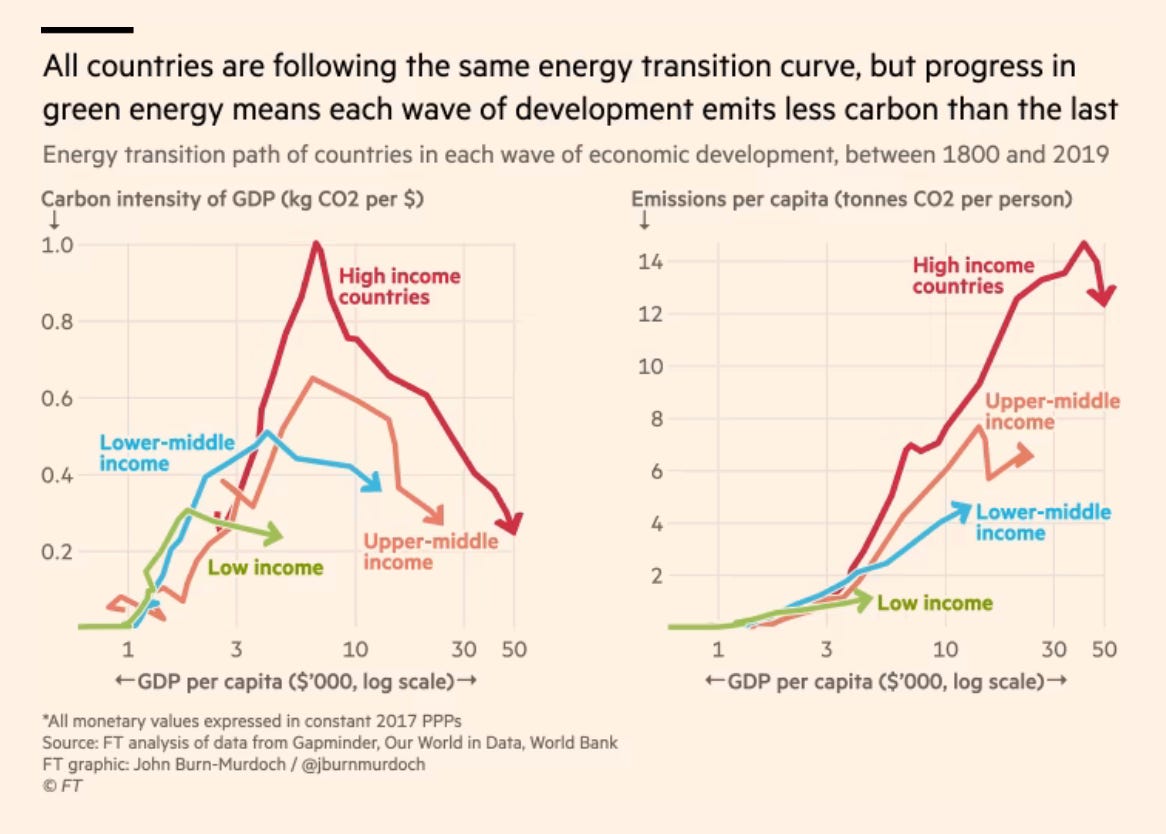
This relationship, known as the Environmental Kuznets Curve, is becoming flatter thanks to the global diffusion of cleaner technology. The chart above shows how peak carbon intensity is falling over time, with poorer countries reducing their emissions per dollar of GDP at much lower income levels than earlier industrializers. The energy think tank Ember recently illustrated this trend by comparing India and China, the former of which is curbing coal use and electrifying its economy at a much lower level of development.


Health & Demographics
The CDC reports that US life expectancy climbed to an all-time high of 79 years in 2024, finally surpassing its pre-Covid level.
Researchers have published the full results of the largest randomized trial of AI cancer screening to date, comparing mammograms read by one radiologist assisted by AI with the standard two-radiologist review. The AI-supported process cut the radiologists’ workload by 44 percent and detected 29 percent more cancers, without additional false positives. Women who received a negative result during their AI-assisted mammogram ended up having 12 percent fewer cancer diagnoses before their next scheduled screening than those in the control group, suggesting that the AI screen missed fewer aggressive cancers.
The Healthy Minds Study, a large survey of US college students’ mental health, shows some improvement between 2022 and 2025: the share reporting severe depression fell from 23 percent to 18 percent, anxiety from 37 percent to 32 percent, loneliness from 58 percent to 52 percent, and suicidal thoughts from 15 percent to 11 percent.
Science & Technology
Paleontologists have published their first comprehensive analysis of a giant fossil site in southern China containing the remains of a 512-million-year-old marine ecosystem. The team analyzed thousands of specimens from the site representing 153 species—nearly 60 percent of them new to science.
Neuralink has now implanted its brain chip in 21 people with paralysis, allowing them to use digital tools like computers and cameras with their minds. According to a company blog post, some chip recipients can now operate a computer as fast or faster than the typical able-bodied user.
Sometime next year, NASA plans to place the first radio telescope on the far side of the Moon. Far away from Earth’s atmosphere and protected from human radio interference, the instrument will be able to measure faint, low-frequency radio signals that are inaccessible from Earth, potentially leading to new discoveries about a wide range of cosmic phenomena.
Love these progress roundups. The Environmental Kuznets Curve flattening is probably the most undereported story, kinda wild that India can skip the worst parts of industrialization that China went through. Also that AI mammography stat is insane, catching 29% more cancers with way less radiologist time sounds like the rare tech win that actually scales. Honestly needed this after endless doom scrolling today.