

Economics & Development
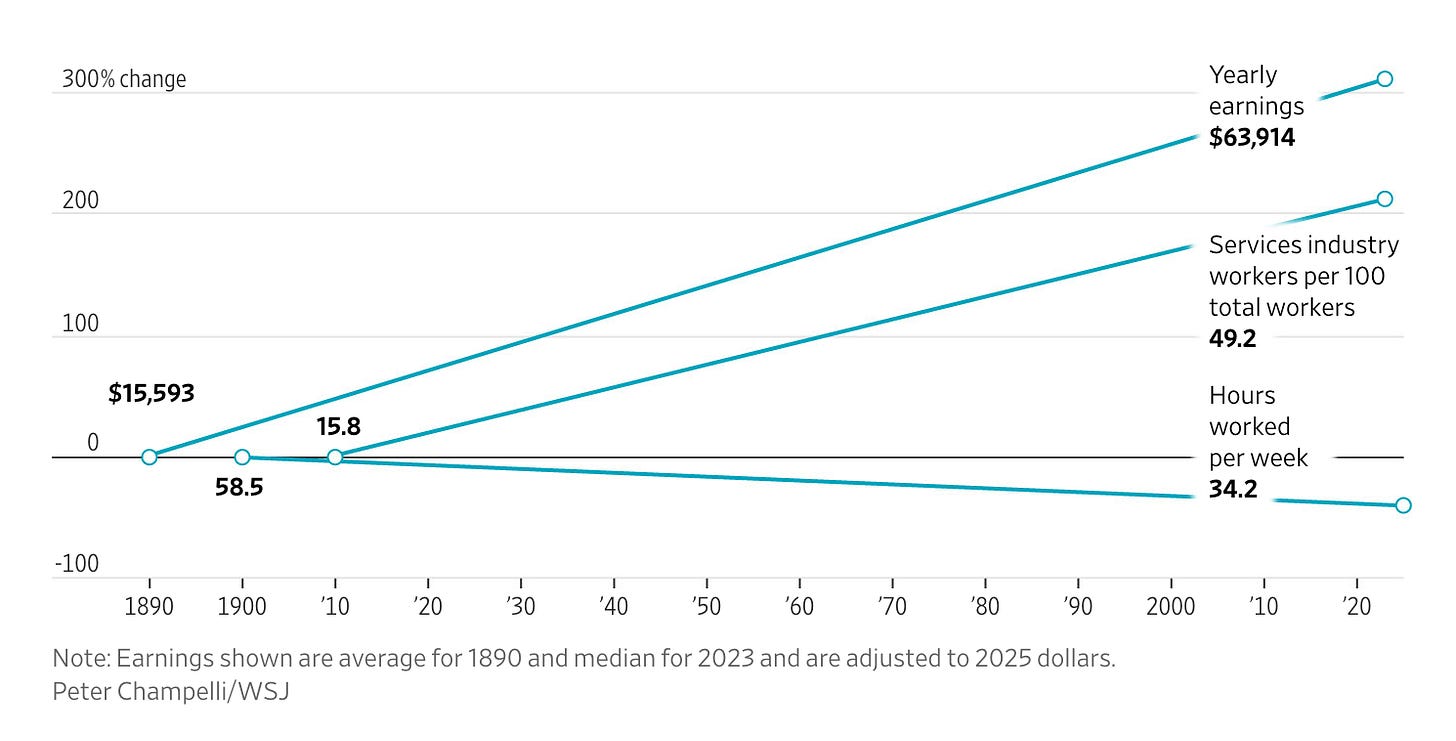
The Wall Street Journal recently published a fascinating set of data visualizations showing how life has changed for the average American worker over the past few centuries. In short, despite all the hand-wringing over our transition out of a manufacturing-dominated economy, the modern worker has a lot to be grateful for.

Energy & Environment
The New York State Department of Health has determined that, thanks to a reduction in water pollution—namely, declining levels of toxic polychlorinated biphenyl compounds (PCBs)—certain fish species in the lower Hudson River are now safe to eat in moderation.
Conservationists in Zambia are using synthetic furs to reduce leopard poaching. An important festival of Zambia’s Lozi people involves dressing up in leopard skins. Rather than trying to end the practice, the cat conservation non-profit Panthera Corporation began distributing ultra-realistic synthetic pelts. According to a recently published study of the program, the fake furs were rapidly adopted by the Lozi and were followed by a drop in poaching incidents and a rise in leopard sightings by camera traps.
The ampurta, a formerly endangered carnivorous marsupial found in Australia, has rebounded in recent years, expanding its range by an area the size of Denmark between 2015 and 2021. Researchers credit some of the resurgence to the 1995 release of rabbit hemorrhagic disease virus, which wiped out large numbers of invasive rabbits in Australia and thereby reduced the population of feral cats and foxes, major predators of the ampurta.
Health & Demographics
In a small trial in China, a single-injection gene therapy improved hearing in all ten congenitally deaf participants. One even gained near-normal hearing within just four months.
The National Highway Traffic Safety Administration reports that traffic deaths in the US were 6.7 percent lower in 2025 than in 2024, reaching the second-lowest death rate per mile traveled ever recorded.
US pedestrian deaths were 10.9 percent lower in the first half of 2025 than in the same period a year earlier, though they remained slightly above the 2019 level.
An experimental hookworm vaccine sharply reduced infection intensity in a Phase 2 trial, with vaccinated participants showing a median of zero detectable worm eggs in their feces after exposure. If approved, this would be the first vaccine for the parasitic disease, which infects hundreds of millions of people each year and is a leading cause of anemia.
Science & Technology
Rapid delivery is not only for urbanites. According to recent reporting in Bloomberg, Amazon now provides two-day delivery to 62 percent of rural and small-town households in the US, and one-day delivery to 20 percent.
Total robotaxi travel distance doubled in California last year, from 3.8 million kilometers per month at the end of 2024 to 9.4 million in December 2025.
Scientists at the Innovative Genomics Institute in California used sorghum leaf cells to model how thousands of genetic tweaks affect photosynthesis, building a detailed map of which changes could plausibly enhance the process. The researchers hope their insights will generalize across crops and offer new ways to increase yields.
A new CRISPR gene-editing technique could make it much easier to engineer staple crops. Using a refined CRISPR enzyme they call CasY7, researchers from the South China Agricultural University were able to edit rice and maize genomes 2.7 times more efficiently than a typical CRISPR system, potentially speeding up the development of higher-yielding, more resilient crops.