

Economics & Development
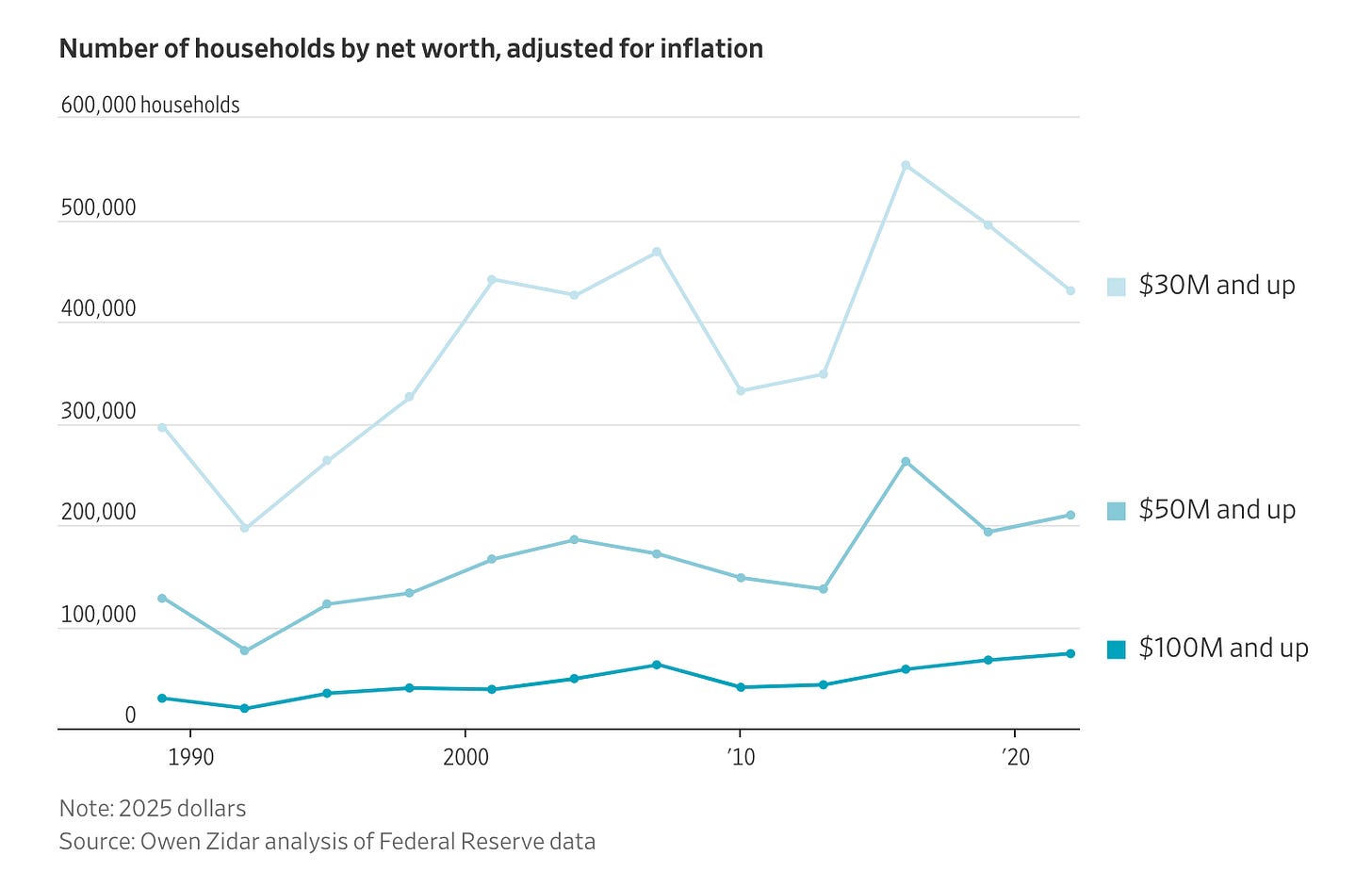
The United States is changing from a middle-class society to one of mass affluence. Data compiled by the economist Owen Zidar show that the number of “ultrawealthy” US households with a net worth of over $30 million (in inflation-adjusted 2025 dollars) is growing faster than the population in general, reaching 430,000 in 2022.
Paraguay’s economy has grown by an average of 4 percent annually for two decades—a record of stability that helped earn it investment-grade credit ratings and is now drawing in foreign investors.

Energy & Environment
There was a bumper monarch butterfly migration to Mexico this winter. The population was 64 percent larger than last year’s and covered the largest land area since 2018. The butterflies remain far below their historical numbers, but seem to have stabilized in recent years.
Southern white rhinos are back in Uganda’s Kidepo Valley National Park for the first time since 1983, when they were extirpated by poachers.
European forests continue to recover from their preindustrial nadir. According to the European Union’s statistical office, forests grew in 2023 in every EU country with data except Estonia.

Health & Demographics
A pill for sleeping sickness that can cure the disease with a single dose has been approved by EU regulators and could be deployed in endemic countries as soon as next year. It’s far easier to administer than the current standard 10-day regimen and could make it much easier to treat patients in remote areas.
A recently published meta-analysis found that people on GLP-1 weight loss drugs lose about the same amount of muscle, relative to total weight loss, as people who lose weight through diet and lifestyle changes.
The FDA has approved a new kind of insulin injection for type 2 diabetes that only needs to be used once a week, rather than the standard daily dose.
Science & Technology
Scientists at CERN have transported antimatter by truck for the first time in history. The goal is to eventually distribute antiprotons to other laboratories in Europe.
A new electric vehicle charging system from the Chinese manufacturing giant BYD can recharge a battery from 10 percent to 70 percent in just five minutes.
The Rwandan government has agreed to expand its partnership with Zipline to build the world’s first nationwide drone delivery network for healthcare. The system will extend beyond rural areas into cities like Kigali, enabling on-demand delivery of blood, vaccines, and medicines across the entire country.
AlphaFold, Google’s AI system that predicts the 3D shapes of proteins, now includes predictions of how proteins pair up and work together in its database. As many proteins only function properly when bound to others, the advance could help scientists better model cells and develop new treatments.
An Australian tech entrepreneur claims he used AlphaFold and ChatGPT to design a customized mRNA cancer therapy for his dog. Working with scientists at the University of New South Wales, the treatment was produced and administered in a matter of months.
Violence & Coercion
The Global Terrorism Index reports that global deaths from terrorism fell by 28 percent from 2024 to 2025, reaching their lowest level since 2007.
Best Friends Animal Society, an animal welfare nonprofit, estimates that the number of cats killed in US shelters has fallen 75 percent over the past decade.