

Economics & Development
A Chinese shipping company has launched the first regular container service between Asia and Europe through the Arctic. The journey from Ningbo, China, to Felixstowe, England, is expected to take around 20 days, roughly half the time it takes to complete the typical route through the Suez Canal.
Europeans are using more air conditioning. The amount of energy used for household cooling in the EU has doubled since 2018, though from a low base. In 2020, American households used around 914,000 terajoules to power air conditioning, compared to just 45,000 in Europe. Chinese air-conditioner exports to the EU reached a record $3.76 billion in the first half of 2026, up 43 percent from a year earlier.
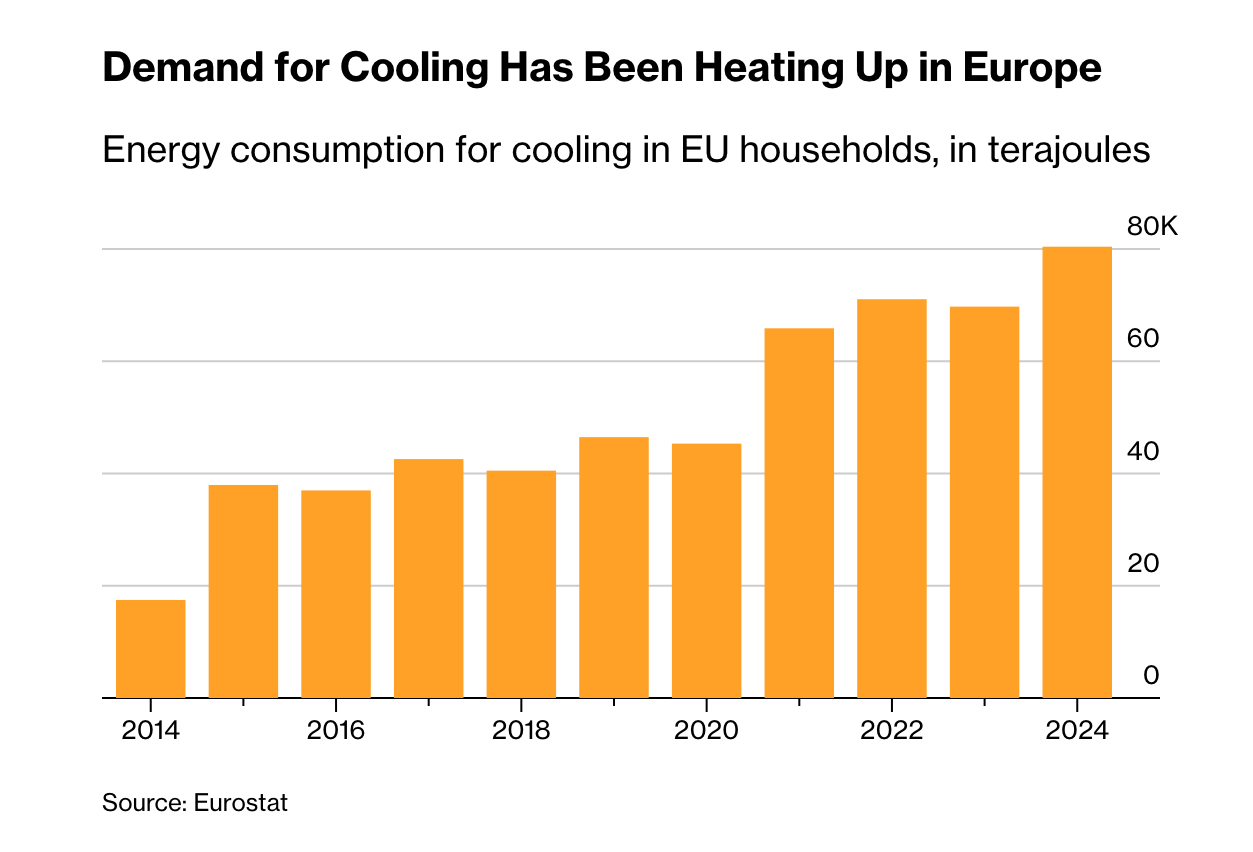
While rising temperatures in Europe have aggravated the need for air conditioning, the region has long suffered from unusually high heat-related mortality.


Health & Demographics
Americans say they are gambling less than they were a decade ago. According to a recent Gallup poll, 45 percent of US adults reported gambling in the past 12 months in 2026, down from 64 percent in 2016.

The government of Zanzibar is using drones as part of its efforts to fully eliminate malaria from the archipelago. Conventional anti-malaria strategies like bed-net distribution, rapid treatment, and insecticide spraying helped bring malaria prevalence in Zanzibar below 1 percent by 2008. Since then, however, progress toward elimination has largely stalled, with malaria transmission fluctuating at low levels. To help finish the job, Zanzibar health officials are using drones to locate stagnant water where mosquitoes lay their eggs, allowing workers to target the sites with larvicide.
According to a recent report from the WHO and UNICEF, the share of health facilities worldwide with basic water services rose to 85 percent in 2025, up from 76 percent in 2015.1

A personalized mRNA cancer vaccine for people with high-risk melanoma has succeeded in a large Phase 3 trial. The treatment, developed by Moderna and Merck, is individually designed from mutations found in each patient’s tumor and trains the immune system to recognize and attack their cancer. The companies have not yet released the full results from the Phase 3 trial. But in earlier Phase 2 results, the vaccine—combined with the immunotherapy drug Keytruda—reduced the risk of recurrence or death by 49 percent over five years versus Keytruda alone.
The FDA has authorized a robot that can draw blood. The machine, called Aletta, uses near-infrared light and ultrasound to locate a vein before autonomously applying a tourniquet, disinfecting the skin, inserting the needle, changing collection tubes, and applying a bandage. The authorization will allow Aletta to be used on adults in clinics and other medical settings where patients do not stay overnight.
Science & Technology
Amazon plans to bring its drone delivery service to nearly 500 cities and towns across the US by the end of 2026. The company says its drones are able to deliver products weighing up to five pounds to customers in as little as 30 minutes.
California regulators have approved a major expansion of Waymo’s driverless taxi service. The company is now authorized to offer paid robotaxi rides across parts of 18 counties, including new areas around Sacramento, San Diego, Orange County, Napa, and the East Bay of San Francisco.
LandSpace, a private Chinese company, has landed a reusable orbital-class rocket booster, becoming the third private company to do so.
Powered exoskeletons are evolving from medical devices to consumer products. Newer systems are far lighter and less cumbersome than their clinical ancestors, allowing them to enhance ordinary movement as well as help restore lost function. One experimental system weighing less than 3 kilograms cut the energy required for younger adults to walk uphill by 18 percent.
Violence & Coercion
The FBI's newly released 2025 data show that the US murder rate fell to a 70-year low in 2025. The overall violent crime rate in 2025 was 9.7 percent lower than in 2024—the biggest one-year drop since at least 1936, when the FBI’s national crime rate estimates began.

A robot that can draw blood! Fascinating… don’t think I wanna be a guinea pig for that… haha