

Economics & Development
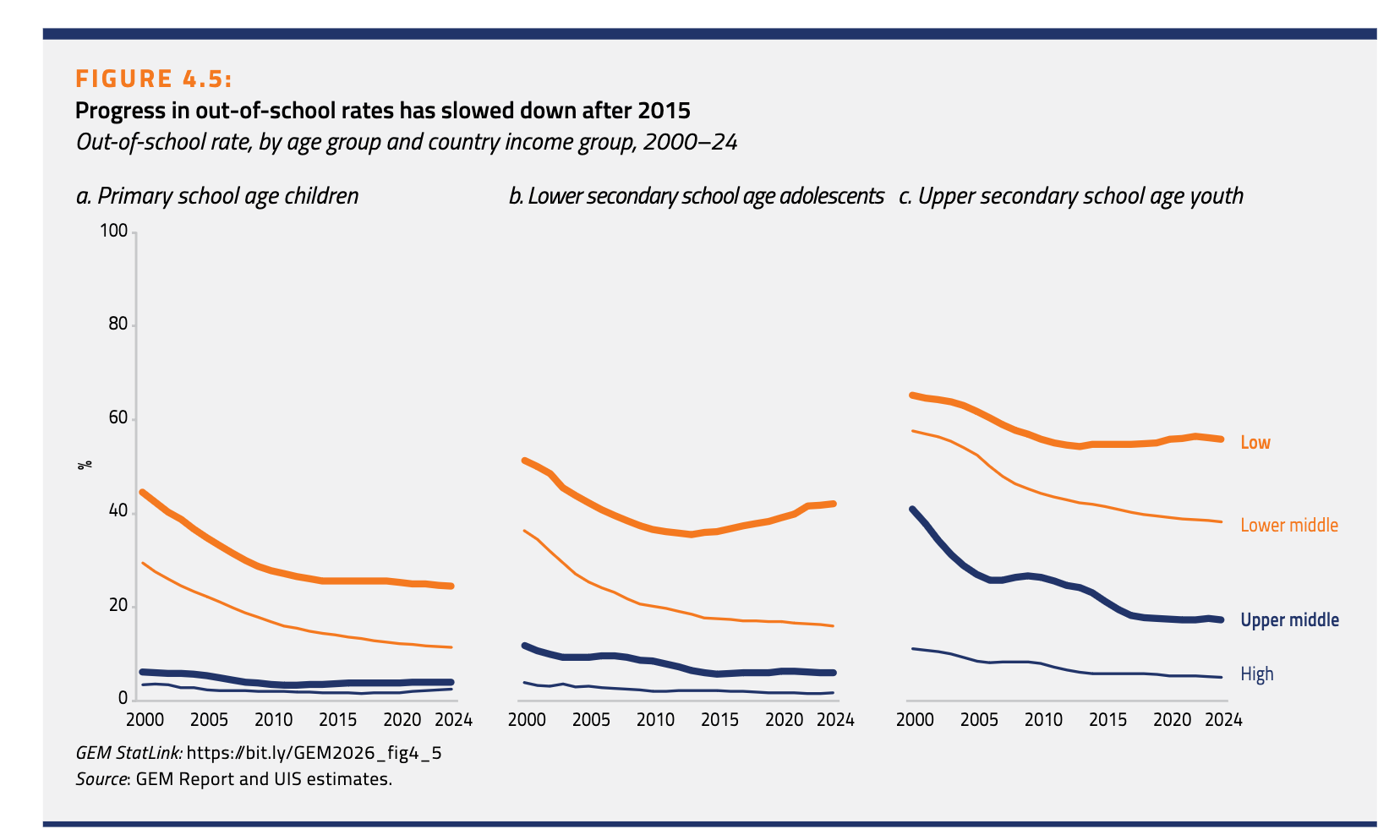
UNESCO recently published an encouraging report on access to education around the world. It finds that 1.4 billion students were enrolled in school in 2024, 30 percent more than in 2000. Over the same period, the global “out-of-school rate,” which measures the share of appropriately aged children who are not enrolled in primary or secondary school, fell from 27.2 percent to 16.8 percent. Unfortunately, the report also notes that enrollment progress has stagnated over the past decade.
Argentina’s national poverty rate fell to 28.2 percent in the second half of 2025, the lowest it’s been since 2018.
Energy & Environment
Koalas in the Australian state of Victoria have long since bounced back from their near-extinction in the early 1900s, but many worried that inbreeding threatened their long-term prospects. Happily, a new genetic database suggests Victorian koala genetic diversity is also recovering.
Whale populations in the Southern Ocean have rebounded to the point that researchers now regularly report spotting pods numbering in the hundreds.
Health & Demographics
An analysis from Brookings finds that US health care spending in 2024 was $977 billion lower than the government projected it would be back in 2010. The authors attribute some of the gap between the projections and reality to technological innovations that have lowered the costs and improved the effectiveness of certain treatments.
CDC data indicate that the decline in US drug overdose deaths continued into October 2025.
Science & Technology
NASA has launched Artemis II. The flight will send four astronauts around the Moon—humanity’s first crewed journey out of low-Earth orbit in over fifty years.
Data centers receive power from utilities in the form of alternating current electricity, but the computers inside them run on direct current. Because of this mismatch, most facilities end up converting electricity multiple times as it moves through the system, wasting energy at each step. This may now be changing: multiple data center infrastructure suppliers are developing new power distribution systems that require only a single AC-to-DC conversion, potentially making future data centers more resource and energy efficient.
ChatGPT has solved a math problem on FrontierMath: Open Problems, a benchmark of unsolved problems designed to test AI systems. This is the first problem from the benchmark to be solved so far.